Submissions

Login or Register to make a submission.

Author Guidelines

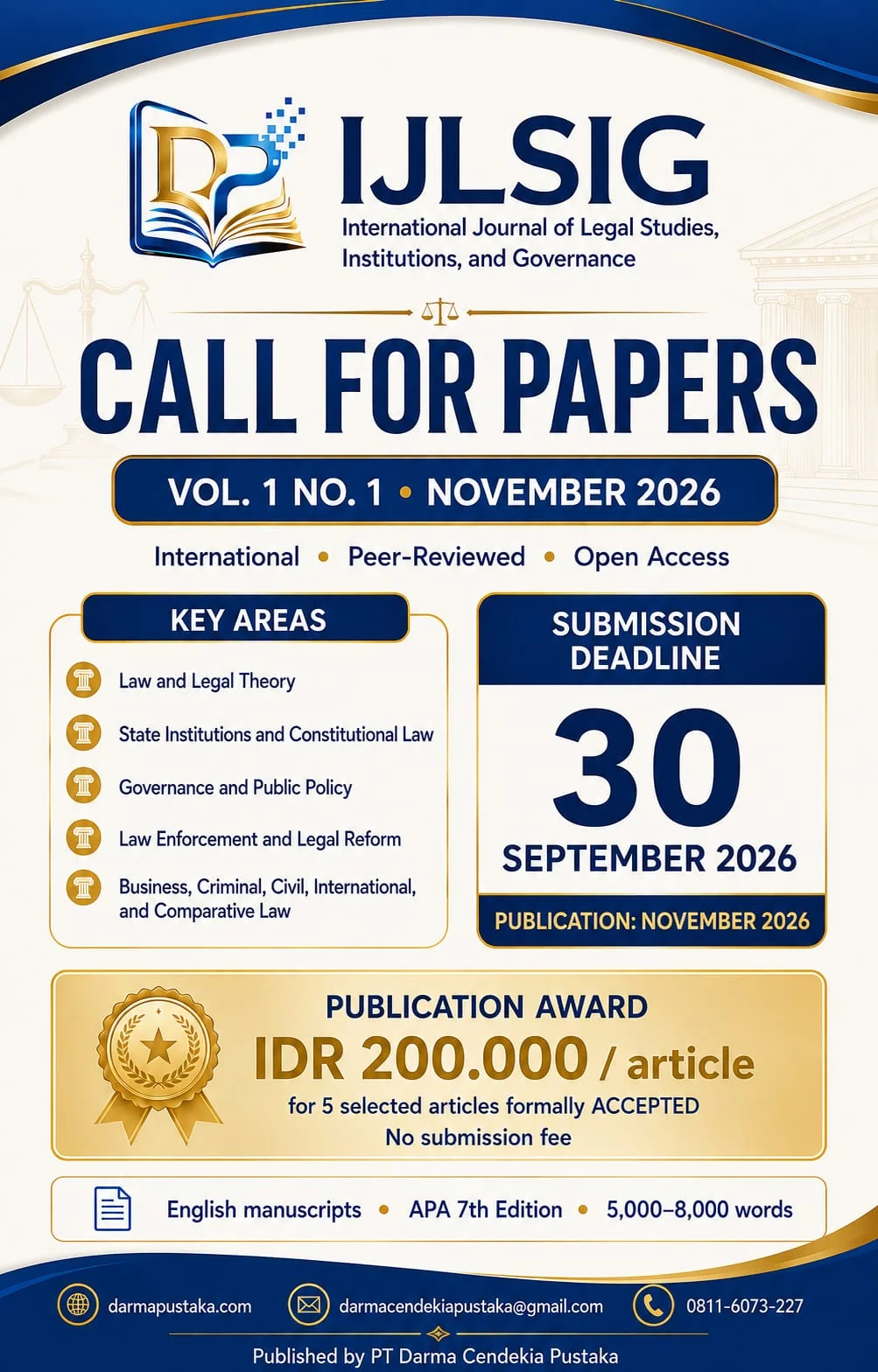
Authors are invited to make a submission to this journal. All submissions will be assessed by an editor to determine whether they meet the aims and scope of this journal. Those considered to be a good fit will be sent for peer review before determining whether they will be accepted or rejected.

Before making a submission, authors are responsible for obtaining permission to publish any material included with the submission, such as photos, documents and datasets. All authors identified on the submission must consent to be identified as an author. Where appropriate, research should be approved by an appropriate ethics committee in accordance with the legal requirements of the study's country.

1. General Information

The International Journal of Legal Studies, Institutions and Governance (IJLSIG) publishes original scholarly manuscripts concerning legal studies, institutions, governance, public administration, constitutional development, law enforcement, and related interdisciplinary fields.

Manuscripts must demonstrate academic originality, methodological clarity, and a meaningful contribution to the development of legal studies, institutional reform, governance, or public policy.

All manuscripts must be written in clear and academically appropriate English.

2. Types of Manuscripts

IJLSIG accepts the following types of manuscripts:

2.1. Original Research Article

An Original Research Article presents findings derived from doctrinal, normative, empirical, socio-legal, comparative, or interdisciplinary research. Its analysis may be based on legislation, court decisions, legal documents, institutional practices, interviews, surveys, observations, or other relevant data.

2.2. Review Article

A Review Article critically examines and synthesises existing scholarship on a particular legal, institutional, or governance issue.

Systematic Literature Reviews should explain the databases, search strategy, keywords, inclusion and exclusion criteria, and the method used to select and analyse the literature. Authors are encouraged to use PRISMA or another recognised review protocol where appropriate.

2.3. Conceptual or Theoretical Paper

A Conceptual or Theoretical Paper develops or critically examines a legal concept, theory, doctrine, institutional framework, or governance model. The manuscript must be supported by a strong theoretical foundation and relevant legal authorities or empirical context.

3. Originality and Exclusivity

A manuscript submitted to IJLSIG must:

1. constitute the authors’ original work;
2. not have been previously published;
3. not be under consideration by another journal;
4. not contain plagiarism, fabrication, falsification, or improper manipulation of data; and
5. obtain the necessary permission for copyrighted material belonging to another party.

Submission of the same or substantially similar manuscript to more than one journal simultaneously is prohibited.

4. Manuscript Structure

Manuscripts should generally follow the IMRaD structure and contain the following components.

4.1. Title

The title must:

1. be written in English;
2. clearly represent the principal subject of the manuscript;
3. contain no more than 15 words;
4. avoid unnecessary abbreviations, jargon, and overly general expressions; and
5. be concise, informative, and suitable for indexing.

4.2. Author Information

Author information must be provided in a separate title page containing:

1. the full name of each author without academic titles;
2. institutional affiliation;
3. city and country of the institution;
4. email address;
5. ORCID iD, where available; and
6. identification of the corresponding author.

To ensure double-blind peer review, the main manuscript must not contain the names, affiliations, acknowledgements, or other information that could reveal the authors’ identities.

4.3. Abstract

The abstract must:

1. be written in English;
2. contain between 200 and 250 words;
3. be presented as one paragraph;
4. briefly explain the background, objective, method, principal findings, and conclusion of the research; and
5. not contain citations, tables, figures, footnotes, or undefined abbreviations.

The abstract must be followed by four to six keywords arranged alphabetically and separated by semicolons.

4.4. Introduction

The Introduction should contain:

1. the background and significance of the subject;
2. the relevant legal, institutional, social, or governance context;
3. a critical review of relevant previous studies;
4. identification of the research problem or research gap;
5. the research question or objective; and
6. the novelty and expected contribution of the manuscript.

The Introduction should not merely provide a general description of the subject but must clearly demonstrate the problem addressed by the research.

4.5. Research Methods

The Research Methods section must explain:

1. the type and approach of the research;
2. the sources and types of legal materials or research data;
3. the techniques used to collect the materials or data;
4. the method of analysis; and
5. any relevant ethical considerations.

Normative or doctrinal legal research should identify the statutory, conceptual, case, comparative, historical, or other legal approaches employed.

Empirical or socio-legal research should explain the research location, population or participants, sampling method, research instruments, data collection procedures, and method of analysis.

A Systematic Literature Review should identify the databases, search terms, period covered, inclusion and exclusion criteria, screening process, and method of synthesis.

4.6. Results

The Results section presents the principal findings of the research clearly and systematically.

Authors may use appropriate subheadings, tables, figures, diagrams, excerpts from legal documents, summaries of court decisions, or other relevant materials. The section should focus on the findings and avoid unnecessary repetition of information.

For doctrinal or conceptual research, this section may present the principal legal findings, doctrinal propositions, regulatory inconsistencies, institutional problems, or conceptual developments identified by the research.

4.7. Discussion

The Discussion must:

1. interpret and critically analyse the research findings;
2. connect the findings with relevant legislation, judicial decisions, theories, and previous studies;
3. explain the novelty and academic contribution of the research;
4. discuss the legal, institutional, governance, policy, or societal implications;
5. identify any limitations of the research; and
6. propose directions for further research where appropriate.

The Discussion should not merely repeat the information presented in the Results section.

4.8. Conclusion

The Conclusion must directly answer the research question and summarise the principal findings of the study.

It should be written concisely in paragraph form and may include legal, institutional, or policy recommendations arising from the research. The Conclusion must not introduce new evidence, arguments, or references that have not been discussed in the manuscript.

4.9. Declarations

Where applicable, the manuscript must contain the following declarations:

1. acknowledgements;
2. funding information;
3. author contributions;
4. conflict of interest statement;
5. research ethics approval; and
6. data availability statement.

4.10. References

The References section must include every source cited in the manuscript. Sources that are not cited in the text must not be included.

Authors must ensure that legislation, court decisions, international instruments, books, journal articles, reports, and electronic sources are cited accurately and consistently.

5. Citation and Reference Style

IJLSIG uses the American Psychological Association Style, 7th Edition—APA 7th Edition.

Bibliographical citations must use the author–date in-text citation system. Footnotes must not be used as a substitute for bibliographical citations. Footnotes may only be used sparingly for brief substantive explanations.

Examples of in-text citations include:

- One author: (Yuriandi, 2025)
- Two authors: (Yuriandi & Faisal, 2025)
- Three or more authors: (Yuriandi et al., 2025)
- Narrative citation: Yuriandi (2025) argues that institutional reform must be supported by effective legal enforcement.
- Direct quotation: (Yuriandi, 2025, p. 25)
- Multiple sources: (Faisal, 2023; Yuriandi, 2025)
- Legislation: (Law No. 40 of 2007 on Limited Liability Companies)
- Court decision: (Constitutional Court Decision No. 91/PUU-XVIII/2020)
- Institutional author: (United Nations, 2024)

Every in-text citation must have a corresponding entry in the References section, and every entry in the References section must be cited in the manuscript.

Authors are strongly encouraged to use reference management software such as Zotero, Mendeley, or EndNote.

6. Reference Requirements

Each manuscript should contain at least 20 scholarly references.

At least 30 per cent of the references should have been published within the five years preceding the submission, except for classical works, foundational legal theories, legislation, court decisions, or historically significant documents.

Authors should prioritise:

1. peer-reviewed journal articles;
2. authoritative academic books;
3. legislation and official regulations;
4. judicial decisions;
5. international legal instruments;
6. official institutional reports; and
7. other credible primary sources.

Personal blogs, anonymous websites, Wikipedia, and other sources without identifiable academic or institutional accountability should not be used as principal references.

Where available, the DOI or permanent URL of a reference must be included.

7. Manuscript Format

Manuscripts must comply with the following technical requirements:

1. file format: Microsoft Word (".doc" or ".docx");
2. paper size: A4;
3. manuscript length: 5,000–8,000 words, excluding references and appendices;
4. font: Times New Roman;
5. font size: 12 points;
6. line spacing: 1.5;
7. margins: 3 centimetres on all sides;
8. text alignment: justified; and
9. page numbers must be included.

Authors must use the official IJLSIG Article Template when it becomes available on the journal website.

8. Tables and Figures

Tables and figures must:

1. be numbered consecutively;
2. have a clear and concise title or caption;
3. be referred to in the manuscript;
4. indicate the source below the table or figure;
5. be submitted in an editable or high-resolution format; and
6. have the necessary reproduction permission where they originate from another source.

Tables should not be submitted as images.

9. Plagiarism and Similarity Screening

Every manuscript will be screened using Turnitin or equivalent similarity-detection software.

The maximum acceptable similarity index is 20 per cent. However, compliance with this numerical limit does not automatically establish that a manuscript is free from plagiarism. The Editorial Team may reject a manuscript containing improper attribution, excessive quotation, disguised copying, or other forms of academic misconduct regardless of its similarity percentage.

10. Peer Review and Revision

All manuscripts that pass the initial editorial assessment will undergo double-blind peer review.

The reviewers’ and authors’ identities will remain confidential during the review process. Authors must submit the required revisions within 14 days of receiving the reviewers’ comments, unless the Editorial Team grants an extension.

A revised manuscript must be accompanied by a response document explaining how each reviewer’s comment has been addressed.

The final decision to accept, request further revision, or reject a manuscript rests with the Editor-in-Chief based on its academic quality, relevance, originality, ethical compliance, and reviewers’ recommendations.

11. Submission Procedure

Manuscripts must be submitted through the IJLSIG Online Journal System.

Authors must upload:

1. a separate title page containing the authors’ identities and affiliations;
2. an anonymised main manuscript;
3. tables, figures, or supplementary materials, where applicable;
4. a declaration of originality and conflict of interest; and
5. any research ethics approval or supporting documentation required for the study.

Submission and communication regarding the manuscript must be conducted by the corresponding author.

12. Submission Checklist

Before submitting a manuscript, authors must ensure that:

1. the manuscript falls within the aims and scope of IJLSIG;
2. the manuscript is original and is not under review by another journal;
3. the manuscript is written in clear academic English;
4. the title contains no more than 15 words;
5. the abstract contains 200–250 words and four to six keywords;
6. the manuscript generally follows the required IMRaD structure;
7. citations and references comply with APA 7th Edition;
8. the manuscript contains at least 20 scholarly references;
9. tables and figures are numbered, captioned, and properly sourced;
10. identifying information has been removed from the main manuscript;
11. the manuscript complies with the formatting requirements;
12. the similarity index does not exceed 20 per cent; and
13. all required declarations and supporting documents have been included.

Submission Preparation Checklist

Before submitting a manuscript, authors must ensure that:

1. the manuscript falls within the aims and scope of IJLSIG;
2. the manuscript is original and is not under review by another journal;
3. the manuscript is written in clear academic English;
4. the title contains no more than 15 words;
5. the abstract contains 200–250 words and four to six keywords;
6. the manuscript generally follows the required IMRaD structure;
7. citations and references comply with APA 7th Edition;
8. the manuscript contains at least 20 scholarly references;
9. tables and figures are numbered, captioned, and properly sourced;
10. identifying information has been removed from the main manuscript;
11. the manuscript complies with the formatting requirements;
12. the similarity index does not exceed 20 per cent; and
13. all required declarations and supporting documents have been included.

Privacy Statement

The International Journal of Legal Studies, Institutions and Governance (IJLSIG) respects the privacy of authors, reviewers, editors, readers, and other users of its journal platform.

  • Compliance & Legal Basis: IJLSIG (operated by PT Darma Cendekia Pustaka, Medan) protects the privacy of all users (authors, reviewers, editors, readers) in accordance with Indonesian Law No. 27 of 2022 on Personal Data Protection.
  • Data Collected: Personal information including full names, email addresses, institutional affiliations, phone numbers, account credentials, manuscript/review records, IP addresses, and payment details (sensitive data is excluded unless legally required).
  • Purposes of Processing: Data is used for OJS account management, handling peer reviews and publications, plagiarism checks, indexing, editorial communications, and legal compliance. Personal data will never be sold or rented for commercial marketing.
  • Published Information: Author names, affiliations, researcher identifiers (ORCID/Scopus), and designated contact details are made public with published articles for scholarly attribution.
  • Confidentiality & Third Parties: Manuscripts and double-blind peer-review processes remain strictly confidential. Data is only shared with trusted service providers for core operations (hosting, DOI registration, indexing, plagiarism detection) or legal obligations.
  • Security & Retention: Admin and technical safeguards protect user data. Information is retained as part of the permanent academic record or as long as necessary for scholarly and legal purposes.
  • User Rights: Data subjects have rights to access, correct, delete, or restrict the processing of their personal data by contacting darmacendekiapustaka@gmail.com.

You can access the full page here: Privacy Statement Page

Last updated: August 2026