Publicarion Ethics and Malpractice Statement
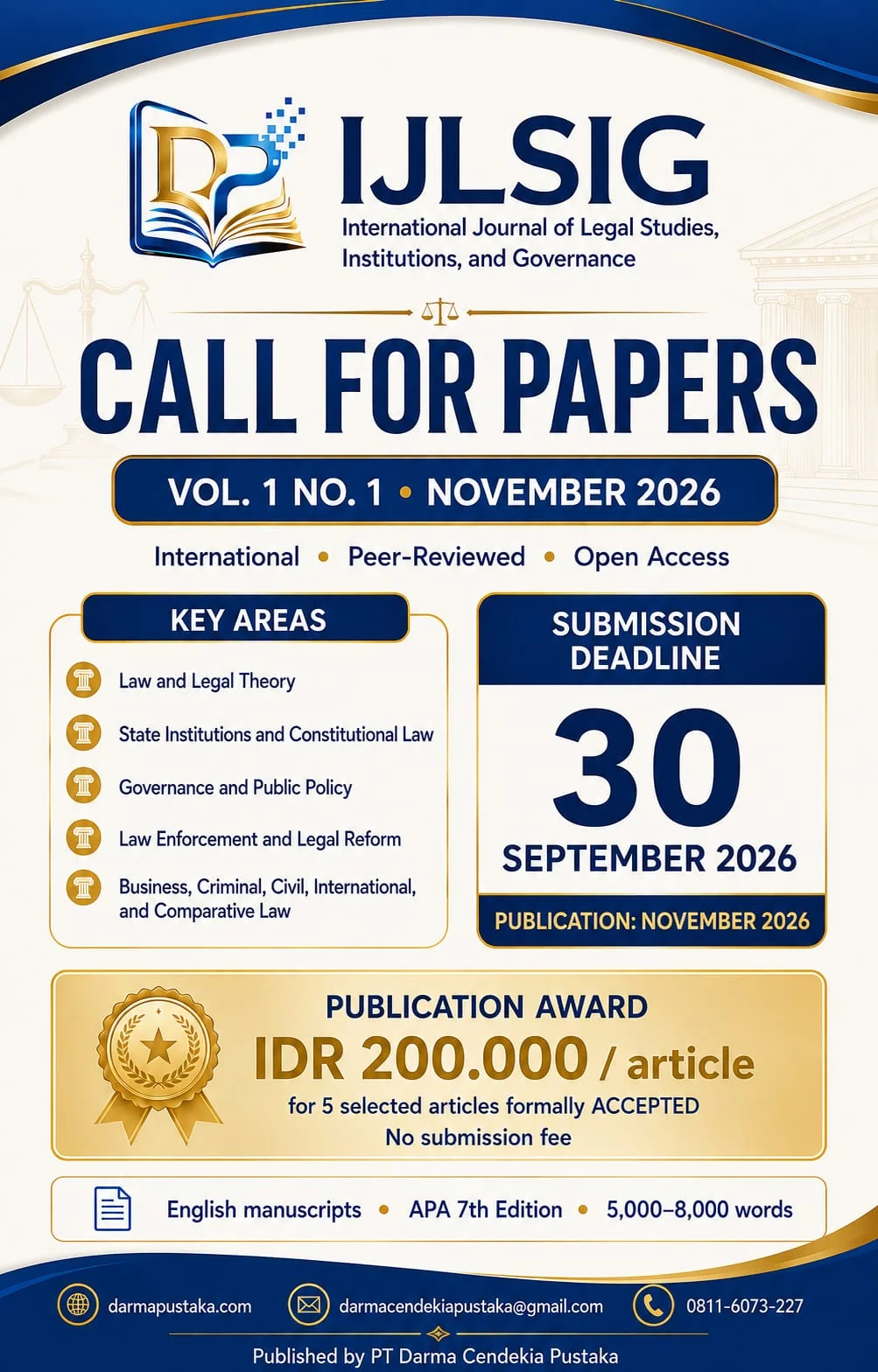
The International Journal of Legal Studies, Institutions, and Governance (IJLSIG) is committed to maintaining integrity, transparency, accountability, fairness, and academic independence. This statement outlines the ethical duties for authors, editors, reviewers, and PT Darma Cendekia Pustaka as the publisher, guided by COPE’s Principles of Transparency and Best Practice in Scholarly Publishing.
General Principles
The International Journal of Legal Studies, Institutions, and Governance (IJLSIG) is committed to maintaining integrity, transparency, accountability, fairness, and academic independence throughout the publication process.
This Publication Ethics and Malpractice Statement applies to authors, editors, reviewers, editorial personnel, and PT Darma Cendekia Pustaka as the publisher.
IJLSIG is guided by the principles and recommendations of the Committee on Publication Ethics (COPE), including the Principles of Transparency and Best Practice in Scholarly Publishing. Reference to COPE standards does not constitute a representation that IJLSIG or PT Darma Cendekia Pustaka is a member of COPE.
Editorial Independence
Editorial decisions are based exclusively on:
- The originality of the manuscript;
- Its relevance to the aims and scope of IJLSIG;
- Academic and methodological quality;
- The significance of its contribution;
- Compliance with publication ethics; and
- Recommendations obtained through peer review.
Editorial decisions shall not be influenced by the author’s nationality, ethnicity, gender, religion, political opinion, institutional affiliation, personal relationship, financial status, or payment of a publication charge.
The publisher shall respect the independence of the Editor-in-Chief and Editorial Team in making academic decisions.
Duties of Editors
Fair and Impartial Evaluation
Editors shall evaluate manuscripts fairly, objectively, and without unlawful discrimination. The identity, affiliation, or personal standing of an author shall not be used as a basis for preferential or adverse treatment.
Confidentiality
Editors shall treat submitted manuscripts and associated correspondence as confidential. Information concerning a manuscript may only be disclosed to the corresponding author, assigned reviewers, editorial personnel, and authorised parties involved in the publication process.
Editors shall not use unpublished information obtained from a submitted manuscript for personal research, professional advantage, financial benefit, or the benefit of another party without the author’s written consent.
Peer-Review Management
Editors shall select reviewers based on relevant expertise and their ability to provide an independent assessment. Editors shall take reasonable steps to prevent conflicts of interest, fabricated reviewer identities, manipulated peer review, and inappropriate interference with the review process.
The final decision remains the responsibility of the Editor-in-Chief, taking into account the reviewers’ recommendations and the journal’s policies.
Conflict of Interest
An editor who has a financial, professional, academic, institutional, or personal conflict of interest concerning a manuscript shall disclose the conflict and withdraw from handling that manuscript. The manuscript shall be assigned to another editor who has no relevant conflict of interest.
Corrections and Misconduct
Editors shall respond to credible allegations of error or misconduct relating to submitted or published work. Where necessary, the journal may conduct an investigation, request clarification or evidence, contact the author’s institution, and publish a correction, expression of concern, or retraction in accordance with the IJLSIG Retraction and Correction Policy and COPE guidance.
Duties of Reviewers
Contribution to Editorial Decisions
Reviewers assist editors in assessing manuscripts and may help authors improve the quality, clarity, and academic contribution of their work. Reviewer recommendations are advisory. The final decision rests with the Editor-in-Chief.
Competence and Timeliness
A reviewer shall only accept an assignment when the manuscript falls within the reviewer’s expertise and the review can be completed within the specified period. A reviewer who lacks expertise or cannot review promptly shall inform the editor and decline.
Objectivity
Reviews shall be objective, constructive, academically reasoned, and supported by clear arguments. Personal criticism, hostile language, discriminatory remarks, or comments unrelated to academic quality are prohibited.
Confidentiality
A manuscript received for review is a confidential document. Reviewers shall not distribute, reproduce, discuss, upload, or disclose the manuscript to unauthorised persons.
AI Restriction: Reviewers shall not upload a confidential manuscript or its contents into publicly accessible artificial-intelligence platforms or external systems that retain or disclose information.
Conflict of Interest
Reviewers shall disclose any actual, potential, or perceived conflict of interest. A reviewer who cannot provide an independent assessment shall decline the assignment.
Acknowledgment of Sources
Reviewers should identify unacknowledged relevant published work and report any substantial similarity, suspected plagiarism, duplicate publication, or data fabrication to the editor. Reviewers shall not coercively request authors to cite their own works without academic necessity.
Duties of Authors
Originality & Similarity Screening
Authors shall submit original work. Plagiarism, self-plagiarism, mosaic plagiarism, contract cheating, data fabrication, citation manipulation, and the purchase or sale of authorship are prohibited.
In accordance with the IJLSIG Plagiarism Policy, overall similarity should normally not exceed 20%, evaluated qualitatively by the editorial team.
Multiple & Duplicate Submissions
Authors shall not submit the same manuscript simultaneously to more than one journal. Duplicate or redundant publication without disclosure is strictly prohibited.
Accurate Reporting
Authors shall present arguments, methods, and conclusions accurately. Falsification, fabrication, selective omission of evidence, or misleading citation of legal materials and court decisions is prohibited.
Authorship Criteria
Authorship is limited to those who made a substantial intellectual contribution. All listed authors must:
- Approve the submitted and final versions;
- Agree to the order of authorship;
- Accept responsibility for their contributions; and
- Be able to respond to questions concerning the integrity of the work.
Administrative or technical support should be acknowledged, not listed as authorship. Guest, honorary, or ghost authorship is strictly prohibited.
Corresponding Author Responsibilities
The corresponding author ensures submission approval, accuracy of metadata/identifiers, disclosure of COI and funding, and co-author communications.
Conflicts of Interest & Funding
Authors must disclose all financial, institutional, professional, or personal interests and external funding sources.
Research Involving Human Participants & Legal Cases
Studies involving interviews, surveys, or human subjects must comply with legal/ethical requirements, obtain institutional ethical approval where necessary, and ensure informed consent and anonymisation.
Legal cases and confidential materials must distinguish established facts from arguments, protect personal data, and respect court orders or professional secrecy.
Citation Practices & Fundamental Errors
Citation padding, citation cartels, coercive citation, and fabricated references are prohibited. Authors discovering significant errors post-publication must notify the editor immediately to issue corrections or retractions.
Use of Artificial Intelligence
Artificial-intelligence tools cannot be listed as authors. Authors remain fully responsible for AI-assisted content. Substantive use of generative AI must be disclosed transparently in the manuscript. AI must not be used to fabricate sources or legal authorities.
Publication Misconduct & Allegations Handling
Publication misconduct includes plagiarism, fabrication, duplicate submission, COI concealment, fake reviewers, citation manipulation, and undisclosed AI use.
Allegations submitted confidentially via email or OJS will undergo initial assessment, notification of the subject, evidence examination, and institutional escalation if necessary. Measure options include manuscript rejection, acceptance withdrawal, formal correction, or article retraction.
Duties of the Publisher
PT Darma Cendekia Pustaka shall:
- Support editorial independence;
- Maintain transparent ownership and contact information;
- Provide reliable journal infrastructure;
- Protect confidential editorial records and personal data;
- Publish fees and business practices transparently;
- Prevent commercial considerations from affecting editorial decisions;
- Support investigations of publication misconduct;
- Maintain published content and post-publication notices; and
- Avoid misleading claims concerning indexing, accreditation, impact, or organisational membership.
Complaints, Appeals & Post-Publication Integrity
Complaints and appeals are handled under the IJLSIG Complaints and Appeals Policy. Published articles will not be silently removed or altered; all post-publication changes will be linked transparently to the original record.
Policy Review
This Publication Ethics and Malpractice Statement will be reviewed periodically to maintain consistency with applicable law, technological developments, and recognised standards of ethical scholarly publishing.
Last updated: August 2026