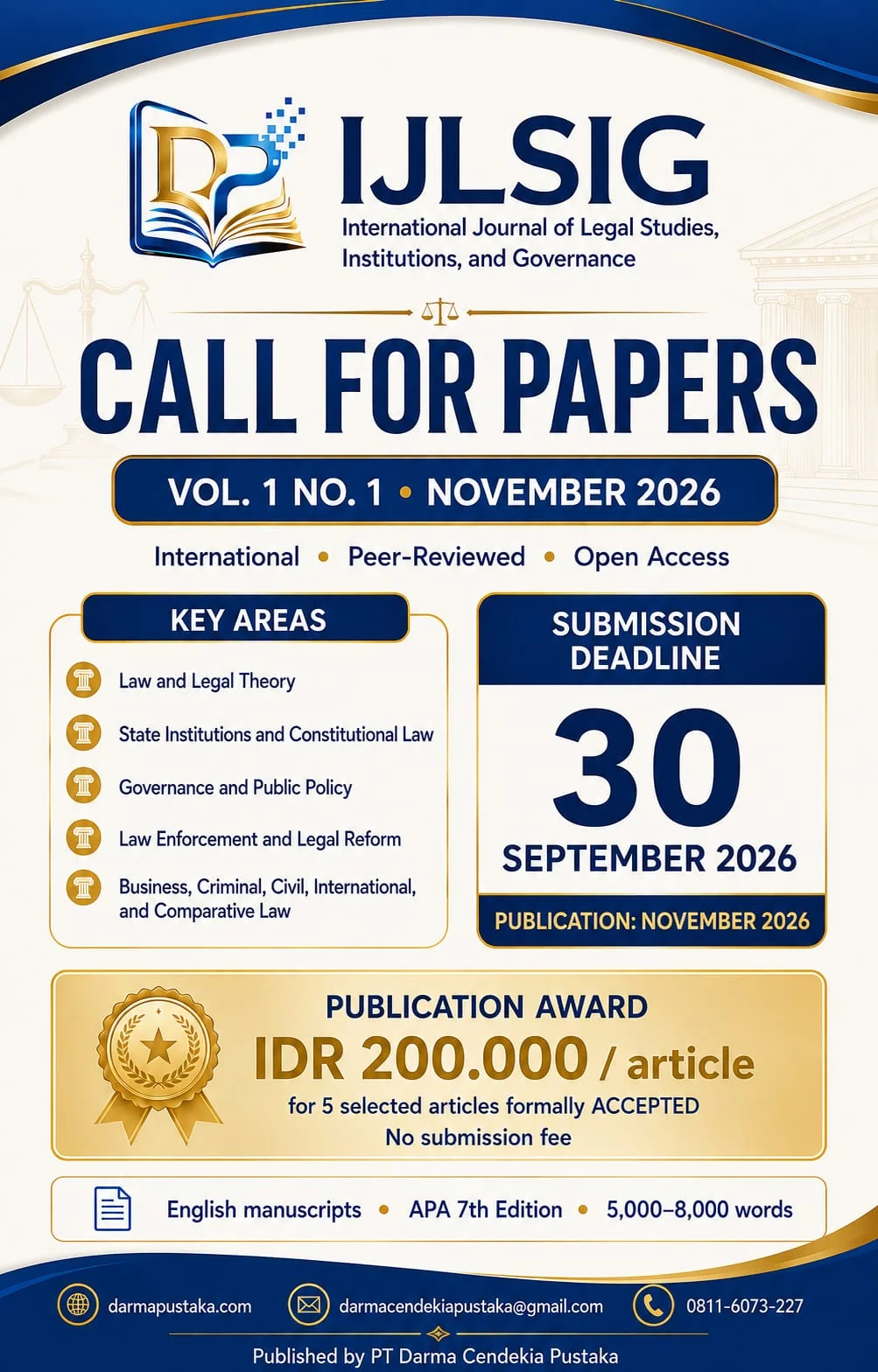
Aims and Scope
The International Journal of Legal Studies, Institutions, and Governance (IJLSIG) aims to provide an international scholarly forum for the development of legal knowledge through critical, original, and methodologically sound research.
Aims
The journal brings together academics, researchers, legal practitioners, judges, public officials, policymakers, and other professionals to examine the relationship between law, institutions, and governance.
IJLSIG seeks to advance legal scholarship by examining law in its normative, theoretical, institutional, and practical dimensions. The journal is particularly concerned with the relationship between law as formally enacted, law as interpreted and applied, law as enforced by institutions, and law as it ought to be in the pursuit of justice, legal certainty, public benefit, and constitutional values.
The journal aims to:
- advance the development of legal theory, doctrine, methodology, and jurisprudence;
- examine the formulation, interpretation, application, and enforcement of legal norms;
- evaluate the structure, authority, performance, and accountability of state and non-state institutions;
- promote research on good governance, the rule of law, democracy, human rights, and institutional accountability;
- identify gaps between legal norms and their implementation in society;
- encourage comparative and interdisciplinary approaches to contemporary legal and institutional problems;
- provide academically grounded recommendations for legal, regulatory, judicial, and institutional reform;
- strengthen dialogue between legal scholarship, legal practice, public administration, and policymaking; and
- connect Indonesian legal scholarship with regional and international academic discourse.
Scope
IJLSIG welcomes original and high-quality manuscripts within the following areas:
1. Legal Theory, Philosophy of Law, and Jurisprudence
Studies concerning the nature, purpose, validity, development, and function of law, including questions of justice, legal certainty, public benefit, legal reasoning, and the relationship between law and society.
2. Constitutional Law and State Institutions
Research on constitutional principles, separation and distribution of powers, checks and balances, constitutional rights, democratic institutions, electoral systems, and the authority and accountability of state organs.
3. Administrative Law and Public Governance
Studies concerning governmental authority, administrative decision-making, public services, administrative accountability, regulatory governance, bureaucratic reform, and legal protection against unlawful government action.
4. Legislation and Regulatory Reform
Research on legislative processes, statutory interpretation, regulatory design, harmonisation of laws, regulatory impact, legal drafting, and the development of future law or lex ferenda.
5. Judicial Institutions and Law Enforcement
Studies concerning courts, prosecution services, police institutions, legal professions, judicial independence, access to justice, dispute resolution, criminal justice, civil justice, and the effectiveness and integrity of law enforcement institutions.
6. Civil Law, Commercial Law, and Corporate Governance
Research on private law relationships, contracts, property, obligations, business organisations, corporations, investment, insolvency, consumer protection, corporate accountability, fiduciary duties, and good corporate governance.
7. Criminal Law and Criminal Justice
Studies concerning criminal law doctrine, criminal responsibility, sentencing, special criminal offences, corporate crime, corruption, restorative justice, victim protection, and the institutional administration of criminal justice.
8. Labour Law and Social Justice
Research on employment relationships, workers’ rights, industrial relations, social security, occupational protection, labour institutions, and legal policies intended to promote social justice and public welfare.
9. Human Rights, Democracy, and Access to Justice
Studies concerning the protection and fulfilment of human rights, equality, vulnerable groups, democratic participation, legal aid, access to justice, and the institutional mechanisms responsible for protecting fundamental rights.
10. International Law and Comparative Legal Studies
Research on public and private international law, international institutions, transnational legal issues, regional legal developments, comparative law, and the transfer or adaptation of legal principles across different legal systems.
11. Environmental Law and Sustainable Governance
Studies concerning environmental protection, natural resources, climate change, sustainable development, environmental justice, and the legal and institutional governance of environmental interests.
12. Law, Technology, and Institutional Transformation
Research on digital governance, artificial intelligence, cybersecurity, data protection, electronic transactions, digital evidence, financial technology, and the legal and institutional consequences of technological development.
13. Socio-Legal and Interdisciplinary Studies
Empirical and interdisciplinary research examining the relationship between law, institutions, governance, politics, economics, sociology, history, culture, technology, and other relevant fields.
IJLSIG accepts doctrinal, theoretical, comparative, empirical, socio-legal, and interdisciplinary legal research. Manuscripts must present a clear legal or institutional problem, apply an appropriate research method, engage critically with relevant authorities and scholarship, and offer an original contribution.
Editorial Exclusion Note: Purely descriptive manuscripts that merely reproduce legal provisions without critical analysis, a clear research problem, and an identifiable scholarly contribution fall outside the journal’s editorial scope.