Peer Review Process
The International Journal of Legal Studies, Institutions, and Governance (IJLSIG) applies a rigorous double-blind peer review process. The identities of the authors are concealed from the reviewers, and the identities of the reviewers are concealed from the authors.
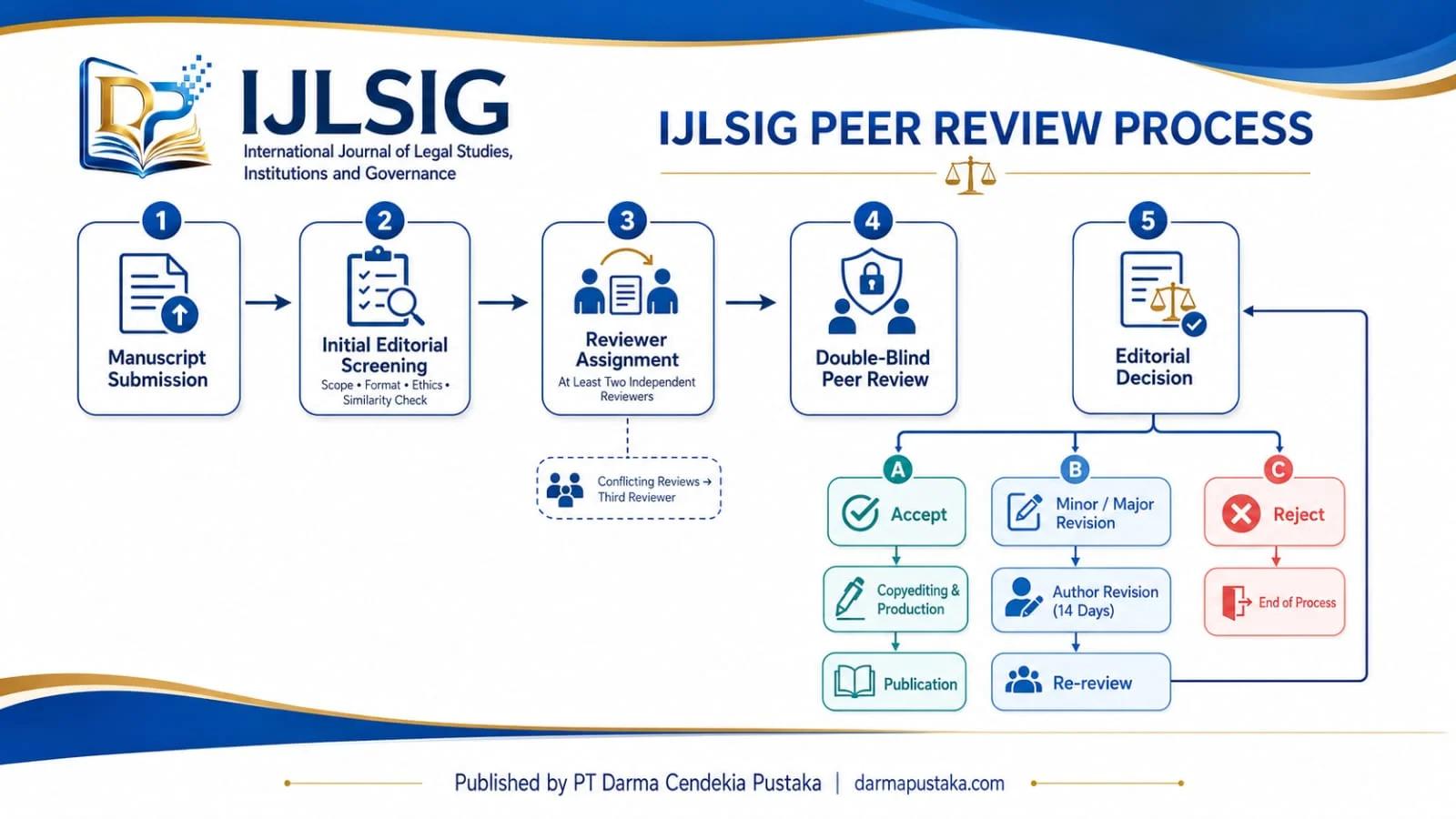
The peer review process is conducted through the following stages:
1. Submission of Manuscript
Authors must submit their manuscripts through the IJLSIG Online Journal System. Each submission must comply with the journal’s Aims and Scope, Author Guidelines, Article Template, publication ethics, and technical requirements.
Note: The manuscript submitted for review must not contain the authors’ names, institutional affiliations, acknowledgements, or other information that could reveal their identities.
2. Initial Editorial Assessment
The Editorial Team conducts an initial assessment to determine whether the manuscript:
- falls within the Aims and Scope of IJLSIG;
- complies with the Author Guidelines and Article Template;
- demonstrates sufficient originality and academic relevance;
- uses an appropriate research method;
- contains a clear research question, novelty, and scholarly contribution;
- complies with publication ethics; and
- meets the journal’s language and technical requirements.
The manuscript will also be screened using Turnitin or equivalent similarity-detection software. The maximum acceptable similarity index is 20 per cent. Nevertheless, the Editorial Team may reject a manuscript containing plagiarism or improper attribution regardless of its similarity percentage.
The Editor-in-Chief may reject a manuscript without external review if it is outside the journal’s scope, lacks sufficient academic quality, violates publication ethics, or does not comply with the submission requirements.
3. Assignment of Reviewers
A manuscript that passes the initial editorial assessment will be assigned to at least two independent reviewers with relevant academic or professional expertise.
The selection of reviewers is based on:
- expertise relevant to the subject of the manuscript;
- academic qualifications and publication record;
- independence from the authors and their institutions;
- absence of any conflict of interest; and
- willingness to maintain the confidentiality of the review process.
If the reviewers provide materially different recommendations, the Editor-in-Chief may appoint a third reviewer.
4. Double-Blind Review
IJLSIG applies a double-blind peer review system. The Editorial Team will take reasonable measures to ensure that the authors and reviewers cannot identify one another during the review process.
Reviewers must treat the manuscript and all related information as confidential. They must not share, reproduce, discuss, cite, use, or distribute any part of the manuscript before its publication.
Reviewers must immediately notify the Editorial Team if they recognise the authors’ identities, have a conflict of interest, or believe they cannot provide an objective assessment.
5. Review Criteria
Reviewers are requested to evaluate the manuscript based on the following criteria:
- relevance to the Aims and Scope of IJLSIG;
- originality and novelty of the research;
- clarity of the research problem and objectives;
- adequacy and transparency of the research methods;
- accuracy and depth of the legal, institutional, or governance analysis;
- engagement with relevant theories, legislation, judicial decisions, and previous studies;
- consistency between the research question, method, results, discussion, and conclusion;
- significance of the manuscript’s academic or practical contribution;
- quality, relevance, and currency of the references;
- compliance with publication ethics; and
- clarity, organisation, and academic quality of the writing.
Reviewers must provide objective, constructive, and evidence-based comments. Personal criticism, discriminatory remarks, and unsupported recommendations are prohibited.
6. Review Period
Reviewers are generally requested to complete their evaluations within two to four weeks after accepting the review assignment.
The review period may be extended where additional time is reasonably required due to the complexity of the manuscript or other relevant circumstances.
7. Review Recommendations
After evaluating the manuscript, each reviewer may recommend one of the following decisions:
- 1. Accept Submission — the manuscript may be published without substantive revision;
- 2. Minor Revision — the manuscript requires limited corrections that do not materially alter its arguments or findings;
- 3. Major Revision — the manuscript requires substantial improvement to its analysis, method, structure, evidence, or discussion;
- 4. Resubmit for Review — the manuscript requires fundamental revision and must undergo another round of peer review; or
- 5. Decline Submission — the manuscript is unsuitable for publication because of serious substantive, methodological, ethical, or other academic deficiencies.
The reviewers’ recommendations are advisory. The final editorial decision remains with the Editor-in-Chief.
8. Revision by Authors
Authors must revise their manuscript in accordance with the reviewers’ and editors’ comments.
The revised submission must include:
- a clean revised manuscript;
- a manuscript showing the revisions, where requested; and
- a point-by-point response explaining how each comment has been addressed.
Where an author disagrees with a reviewer’s recommendation, the author must provide a clear, respectful, and academically reasoned explanation.
Authors must normally submit the revision within 14 days. An extension may be granted upon a reasonable written request submitted before the revision deadline.
Failure to submit the revision within the specified period without prior communication may result in the submission being closed or treated as a new submission.
9. Further Review
A revised manuscript may be returned to the original reviewers or assigned to other reviewers where the Editor-in-Chief considers further evaluation necessary.
The review and revision process may continue for more than one round until the manuscript satisfies the journal’s academic, ethical, and technical standards.
A request for revision does not constitute a guarantee that the manuscript will ultimately be accepted.
10. Final Editorial Decision
The Editor-in-Chief makes the final decision after considering:
- the reviewers’ reports and recommendations;
- the authors’ revisions and responses;
- the manuscript’s originality and scholarly contribution;
- compliance with publication ethics;
- conformity with the journal’s Aims and Scope; and
- the overall academic quality of the manuscript.
The final decision may be to accept, request further revision, or reject the manuscript.
Once accepted, the manuscript will proceed to copyediting, layout editing, proofreading, and publication. The Editorial Team may make necessary corrections concerning grammar, consistency, citation format, and journal style without altering the substance of the authors’ arguments.
11. Conflict of Interest
Editors and reviewers must disclose any actual, potential, or perceived conflict of interest relating to the manuscript or its authors.
An editor or reviewer who has a personal, professional, institutional, academic, or financial relationship that could affect their objectivity must withdraw from the review or decision-making process.
Where the Editor-in-Chief has a conflict of interest, responsibility for managing the manuscript and making the editorial decision will be delegated to another qualified editor.
12. Confidentiality
All manuscripts, review reports, editorial communications, and related documents must be treated as confidential.
Reviewers and editors must not use unpublished information, arguments, data, or ideas contained in a submitted manuscript for personal advantage or for the benefit of another party.
The confidentiality obligation continues after the review process has concluded, regardless of whether the manuscript is accepted or rejected.
13. Ethical Concerns During Review
If a reviewer identifies suspected plagiarism, duplicate publication, fabricated or falsified data, undisclosed conflict of interest, improper authorship, citation manipulation, or other forms of research misconduct, the reviewer must confidentially notify the Editorial Team.
The Editorial Team will examine the allegation in accordance with the Publication Ethics, Plagiarism Policy, Retraction and Correction Policy, and other applicable IJLSIG policies.
14. Complaints and Appeals
Authors may submit a reasoned appeal against an editorial decision if they believe that a material error occurred during the review or decision-making process.
Disagreement with a reviewer’s academic assessment alone does not automatically constitute sufficient grounds for an appeal.
Complaints and appeals will be handled separately under the IJLSIG Complaints and Appeals Policy. An appeal will not be decided solely by an editor whose decision or conduct is the subject of the appeal.
15. Editorial Independence
All editorial decisions are made independently based on academic merit, relevance, originality, ethical compliance, and the quality of the manuscript.
The publisher, sponsors, institutions, authors, reviewers, or other external parties must not improperly influence the peer review process or the final editorial decision.